onsdag 25. september 2013

Girl in (a weird) Landscape


My experience while reading “ Girl in Landscape” was interesting because it did not stay as a constant feeling – for most of the time I really disliked it (but only because of the way it was formulated) but at others it would surprise me and make me want to read more. I’m not at all opposed to the story, and quite enjoyed leaning back and imagining this world that Lethem cleverly created. However I've actually never heard of anything called “coming-of-age” – novels and eventhough it’s a pretty straightforward term; after reading about it, it was still hard for me to understand the concept.
First time I started on the book I tried to listen to the audio version first, but it was very difficult to grasp the storyline with such a loud and annoying “soundtrack”. Consequently I fast gave that up and tried reading the book for real this time– with more success and less annoyance. It’s an okay book – I’d probably give it a 5/6 out of 10 – but if I have one, just one, pet peeve with books it is if the technical part of the writing is bad. The experience of reading a badly written good story (here, Girl in Landscape), is worse than reading a badly written bad story (for example, 50 Shades of Grey), or a good written bad story (like many books). To me at least, the experience is non-enjoyable and reminiscent of literature torture – just because I’m too stubborn to stop reading a book before the finish, and well-read enough to know quickly whether I like a text or not (because I'm not at all implying that I am a good writer).
That said, I have a weakness for voyerism, and Lethem's "Girl in Landscape" is full of it - from beginning to end there is a feeling that the reader is there to observe, just as Pella is observing everyone else all the time - and in return there is a distinct distance between the reader and the characters in the book, and between themselves. It seems like a cold world that they live in - whichever planet they live on.
Something I also noticed is, while I was reading I would switch from imagining night and day because it is so emphasized throughout the whole story and it’s really one of the few things that are new for Pella and not for me – and one of the few things that we have in common from both our worlds. Everytime the narrator introduced something new to the reader – which was all the time basically – like the fishpotatoes or when Pella finds out she can inhabit the housholddeer (or the concept of housholddeer itself), it was extremely interesting.. Still, my pet peeve did not allow me to fully enjoy the experience with Pella and her family. 

tirsdag 10. september 2013

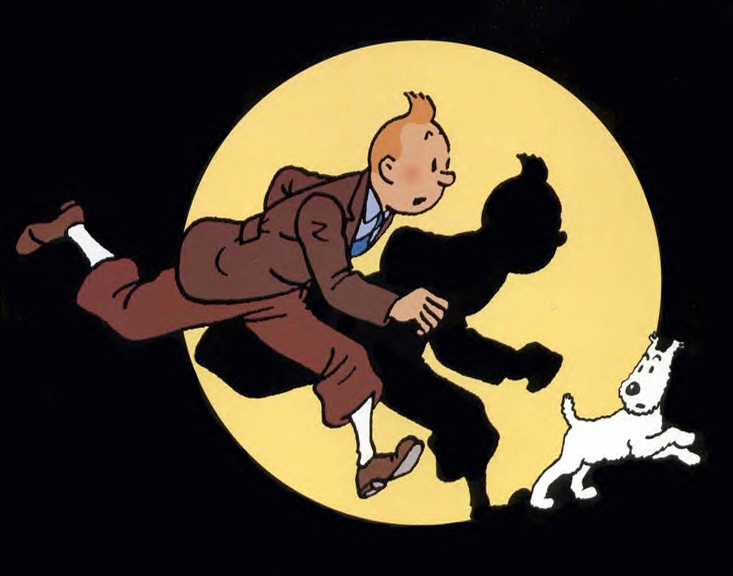
The Adventures of TinTin


Cartoons – or more specifically comic-strips, I guess - are the perfect transmedia as it not only mixes drawings with text; making it easy for both adults and kids, but also because earlier in history (and still today) it were displayed in a way that it was easily accessible for everyone of all ranks of society. Newspapers have featured a couple of comic-strips on one permanent page; all over the world and for many, many years.

To me, the nice and appealing thing about comics (I don’t know whether they can actually be called this but I’ll do that for now) are the fact that you can understand it by only looking at the drawings or only reading the text but there is still left out something for the imagination. Onomatopoetikon are used frequently in the cartoons, and you can imagine the noises and voices of the characters yourself – and I guess in a weird, psychological way they become closer to you as a reader. In TinTin in Tibet for example, there was on a number of occasions some different language characters (apart from the Latin alpahbet), which you then had to imagine in your head. However you “audiolize” the sounds will maybe tell you something about yourself. 

TinTin is definitely a favorite of mine as it does not only have one main character – Captain Haddock, Snowy (and Professor Calculus and Thomson & Thompson; but they do not appear in Tibet) are all the main character during one period or another.

Again, and also specifically with me (as I grew up with TinTin), there has to be a conversation about how it crosses many different media - in this case book/newspapers and TV. My personal experience was dominated primarily by the Adventures of TinTin-cartoon on TV – which came out one year before I was born, 1991. Seeing it on TV is obviously a totally different experience than actually reading it –and I was left with very mixed feelings when I saw the TV series over again with the cartoon-novel fresh in mind.  I have to admit the yeti sounded a lot more terrifying on the youtube-video but other than that I cannot say it impressed me a lot. Also TinTin’s voice annoyed me, and the fact that they took out the part where the Captain drinks a bottle of whisky (also the part about Chang having survived on birds and rodents, are replaced with roots and seeds.). On the other hand it was fun seeing the really weird dream involving Pr. Calculus and a number of umbrellas (which I guess in the movie was induced by a heatstroke). Besides they included the very first dreamscene where TinTin dreams about Chang in the planecrash – which in the comic-strip was never showed… TinTin just wakes up shouting “Chang”, and dream is left out to the reader’s imagination.

I’m not sure whether I can do this but, anyway:
here is the link to TinTin in Tibet:

And don’t skip over the intro – the song is kind of nice (or maybe it’s just my nostalgia). 


PS: I've never watched the movie and neither do I want to, so I chose not to talk about it. 

mandag 2. september 2013

The Great Gatsby – a great literate work


For the second and maybe last time, I will start this reflection off emphasizing how I am not from the United States. This is of outmost importance as the assumptions I bring to the reading, and the judgments I make while I read – is shaped by my childhood in Norway but also the last three years I have lived here in Florida. As a legal alien, and even as a tourist before, I have only seen Florida and had the luxury of staying a short week in New York City. Consequently, and what I’m trying to say, is that the typical American (in my eyes) are defined per Floridian, which I find very different from, say, a native to New Yorker City. So when I have the chance of getting to know “another” American culture AND a historical time I find a particular interest in of course I would read it. I had to this time, butSimilarly this is why I loved The Great Gatsby. 

F. S. Fitzgerald gives the reader a very thin slice of history; a taste of upper-class Long Island in the early years of Prohibition and organized crime. Whether it is a lifestyle that attracts you or not; the author constantly challenges the morals of the reader. So it definitely is not a walk in the park kind of book – despite the seemingly lack of action.. it is more a fiction analyzes of  human behavior and tells you a lot more about yourself than many other books. For example, many people hate Tom; from the very beginning he is portrayed by the narrator as a scary and dislikable character. Still, I don’t find him half as slimy and sneaky as our above-mentioned narrator; Nick. Through him we get fooled to think he might be an outsider – that we are an outsider with him - however, as the story unfolds I realize he might not be as innocent as he puts himself out to be. Nick deliberately, I think, hides his personal life from us readers, just like Gatsby hides his life from everyone else than Daisy (and Nick in the very end). He is as much of a cheater as any of the other characters but he tries to give the reader as little a chance to judge him as one of them. Why that is I don’t know but it definitely gives an interesting twist to the story! After having turned the last page, I was left with a feeling of wanting to know more – what happened to Daisy (and her daughter), and what become of Nick? And that is always a sign that it is a good book – when you want to read more and you just cannot.  

søndag 25. august 2013

Gold and Bread


When reading my comparison of the Wonderful Wizard of Oz with The Hunger Games, it is important to keep in mind that I am not American. Or even close; however having lived in Florida for two years now I can allow myself to say that I am starting to understand Americans (a little better). The Wonderful Wizard of Oz, from now on referred to as WWO, was never a part of my life, though I was convinced by a friend to see the Wicked musical – consequently I had some background on how this story goes. 

To start off I would say that eventhough the stories are written hundred years apart and contain slightly different characters and places, they still seem to talk about contemporary political issues and social behavior. Take the lead characters – Dorothy and Katniss – both strong, young, individuals representing something bigger than them. Again, being not-American makes me feel like these two girls stand for what Americans want to be – or the American spirit maybe. In the very end it is their honesty and belief in what is the right thing to do, that saves them.  Dorothy is naïve while Katniss is borderline paranoid – and they are sick of

The worlds in which the stories are being told are Oz, (the abbreviation of gold from the periodic table), and Panem (which means bread; and comes from the roman saying “bread and circuses”). That is essentially what Panem and Oz really is presented to us like – the leaders of the society gives out all kinds of goods and food, while all the time keeping the rest of the people entertained – and no one has dared to break this bubble until our main characters show up. The Capitol resembles the Emerald city, while Oz and Panem on a whole seems to be allegories for the U.S. Well, Panem might be more of a global allegory, just because we can make it that way – it just challenges the political, and global, issues we have today and that we, especially in the West, are totally okey with. There is a much bigger difference between rich and poor today, and back in the beginning of 1900s that was a big issue in the US as well. In the end of Hunger Games, I mean in the end end of the third book, Katniss with the opposition in her back, takes down the “unjust” leaders of Panem, while Dorothy, without intentions, takes down the Witch of the West and East and uncovers the truth about the Wizard.  I guess both the works are a way for the authors to express their discomfort with the world around them, but also a mean of bringing hope. A hope that someone – other than themselves maybe, ha ha – will save all of us from these “evil” times. 

Another cute similarity between the books is how color and clothing, more specifically dresses, gives another boost to the stories. Katniss dress, and herself on occasion, is literally on fire – a reflection of her hot-temper and headstrong nature. Dorothy on the other hand, just wants to change into a clean dress – which happens to be white and blue; respectively the symbol of a good witch and Munchkins’ favorite color.  And this also happens to give her a more comfortable trip to the Emerald City. To conclude I would say these literal works share more similarities than what first catches your eye – or watch the movies, which definitely don’t do justice to the written text.  Also, again, being not-American did make a difference when I read and compared both books, but not in a significant way.